
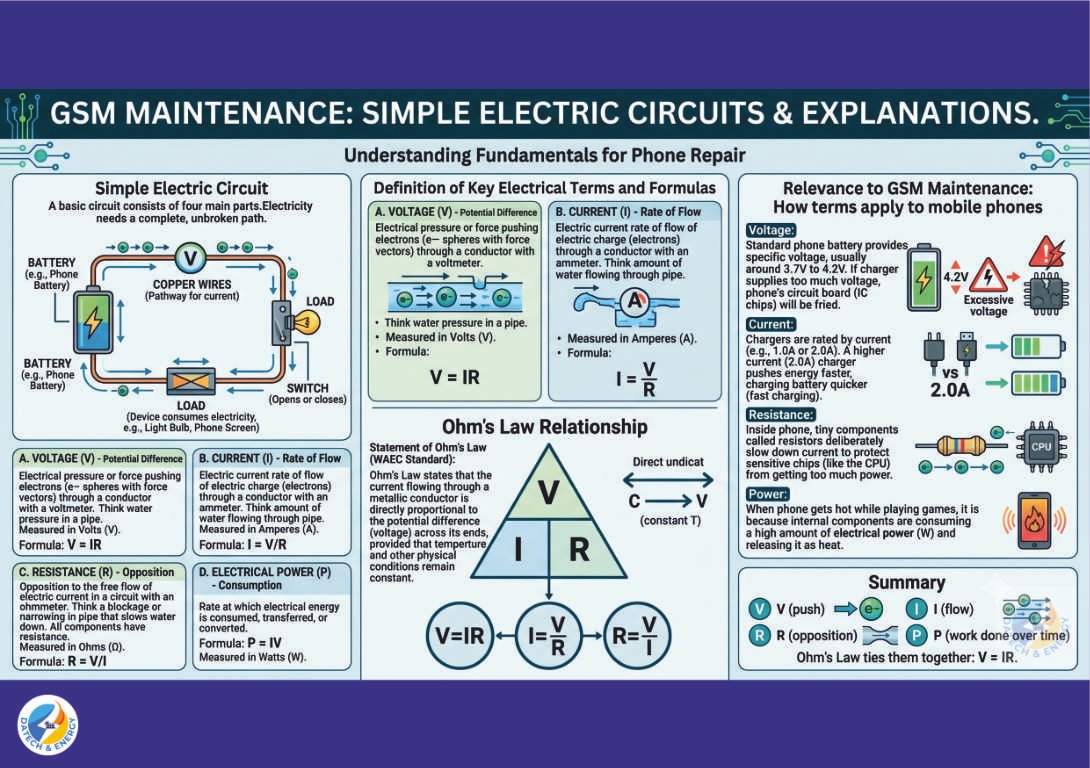
 Simple Electric Circuit
A simple electric circuit is a closed path or loop that allows electric current (electrons) to flow. For electricity to do any useful work (like lighting up a phone screen), it needs a complete, unbroken path. A basic circuit consists of four main parts:
1. Power Source: Provides the energy (e.g., a battery).
2. Conductor: The pathway for the current (e.g., copper wires).
3. Load: The device that consumes the electricity (e.g., a light bulb, a phone’s speaker).
4. Control Device: Opens or closes the circuit (e.g., a switch).
Definition of Key Electrical Terms and Formulas
To understand how circuits work, especially in mobile phones, we must understand four fundamental quantities.
A. Voltage (V) Voltage, also known as Potential Difference (p.d.), is the electrical pressure or force that pushes electrons through a conductor. Think of it as the water pressure in a pipe. Unit of Measurement: Volts (V). Measuring Instrument: Voltmeter. Formula: V = IR
B. Current (I) Electric current is the rate of flow of electric charge (electrons) through a conductor in a circuit. Think of it as the actual amount of water flowing through the pipe. Unit of Measurement: Amperes or Amps (A). Measuring Instrument: Ammeter. Formula: I = V/R
C. Resistance (R) Resistance is the opposition to the free flow of electric current in a circuit. Think of it as a blockage or a narrowing in the water pipe that slows the water down. All components, even wires, have some resistance.
Unit of Measurement: Ohms (Omega).
Measuring Instrument: Ohmmeter.
Formula: R = V/I
D. Electrical Power (P) Power is the rate at which electrical energy is consumed, transferred, or converted into another form of energy (like heat or light) in a circuit. Unit of Measurement: Watts (W) Formula: The basic formula is P = IV. Ohm’s Law Ohm’s Law is the most important rule in basic electronics. It explains the relationship between Voltage, Current, and Resistance.
Statement of Ohm’s Law (WAEC Standard): “Ohm’s Law states that the current flowing through a metallic conductor is directly proportional to the potential difference (voltage) across its ends, provided that temperature and other physical conditions remain constant.”
Relevance to GSM Maintenance
How do these terms apply to mobile phones?
Voltage: A standard mobile phone battery provides a specific voltage, usually around 3.7 V to 4.2 V. If you use a charger that supplies too much voltage, you will fry the phone’s circuit board.
Current: Chargers are rated by current (e.g., 1.0A or 2.0 A. A higher current (2.0 A}) charger pushes energy faster, charging the battery quicker (fast charging). Resistance: Inside the phone, tiny components called resistors deliberately slow down current to protect sensitive chips (like the CPU) from getting too much power.
Power: When a phone gets hot while playing games, it is because the internal components are consuming a high amount of electrical power (W) and releasing it as heat.
Summary Voltage (V) is the push. Current (I) is the flow. Resistance (R) is the opposition. Power (P) is the work done over time. Ohm’s Law ties them together: V = IR.
Evaluation: Objective Questions (Mock)
1.What is the SI unit of electrical resistance? A) Volts B) Amperes C) Ohms (Omega) D) Watts
2.According to Ohm’s law, if the resistance in a circuit remains constant and the voltage is doubled, what happens to the current? A) It is halved. B) It is doubled. C) It remains the same. D) It becomes zero.
Essay Questions:
1. State Ohm’s Law. (2 marks)
2. Define the following terms and state their SI units: a) Voltage b) Current c) Resistance (6 marks)
3. A mobile phone charger supplies a current of 2 A} at a voltage of 5V. Calculate the electrical power of the charger. (Show your formula). (3 marks)