
Topic: GSM Phone Accessories and Functions
In mobile telecommunications, GSM phone accessories are auxiliary hardware components or attachments that are not strictly essential for the fundamental operation of the phone, but are added by the user to enhance its performance, usability, safety, or aesthetic appeal. While a phone can make calls and send texts without them, accessories add convenience, extend the lifespan of the device, and allow the user to maximize the phone’s capabilities.
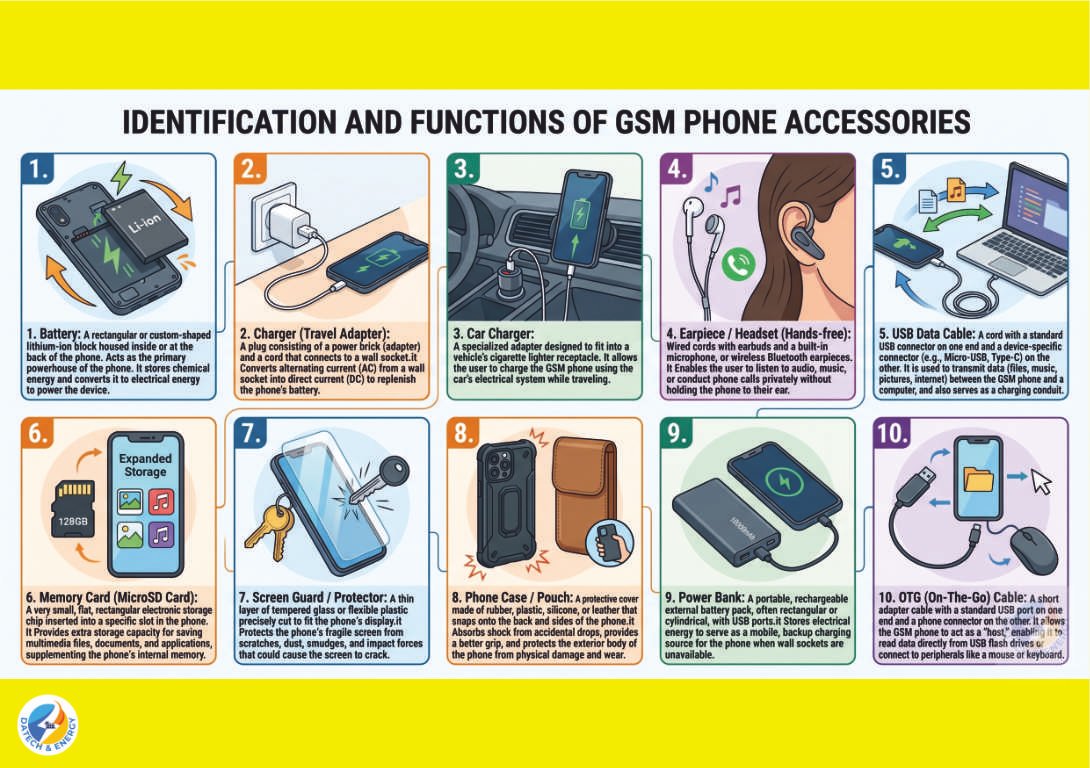
Identification and Functions of GSM Phone Accessories
1. Battery: A rectangular or custom-shaped lithium-ion block housed inside or at the back of the phone. Acts as the primary powerhouse of the phone. It stores chemical energy and converts it to electrical energy to power the device.
2. Charger (Travel Adapter): A plug consisting of a power brick (adapter) and a cord that connects to a wall socket.it Converts alternating current (AC) from a wall socket into direct current (DC) to replenish the phone’s battery.
3. Car Charger: A specialized adapter designed to fit into a vehicle’s cigarette lighter receptacle. It allows the user to charge the GSM phone using the car’s electrical system while traveling.
4. Earpiece / Headset (Hands-free): Wired cords with earbuds and a built-in microphone, or wireless Bluetooth earpieces. It Enables the user to listen to audio, music, or conduct phone calls privately without holding the phone to their ear.
5. USB Data Cable: A cord with a standard USB connector on one end and a device-specific connector (e.g., Micro-USB, Type-C) on the other. It is used to transmit data (files, music, pictures, internet) between the GSM phone and a computer, and also serves as a charging conduit.
6. Memory Card (MicroSD Card): A very small, flat, rectangular electronic storage chip inserted into a specific slot in the phone. It Provides extra storage capacity for saving multimedia files, documents, and applications, supplementing the phone’s internal memory.
7. Screen Guard / Protector: A thin layer of tempered glass or flexible plastic precisely cut to fit the phone’s display.it Protects the phone’s fragile screen from scratches, dust, smudges, and impact forces that could cause the screen to crack.
8. Phone Case / Pouch: A protective cover made of rubber, plastic, silicone, or leather that snaps onto the back and sides of the phone.it Absorbs shock from accidental drops, provides a better grip, and protects the exterior body of the phone from physical damage and wear.
9. Power Bank: A portable, rechargeable external battery pack, often rectangular or cylindrical, with USB ports.it Stores electrical energy to serve as a mobile, backup charging source for the phone when wall sockets are unavailable.
10. OTG (On-The-Go) Cable: A short adapter cable with a standard USB port on one end and a phone connector on the other. It allows the GSM phone to act as a “host,” enabling it to read data directly from USB flash drives or connect to peripherals like a mouse or keyboard.
Importance of GSM Accessories
1. Protection: Items like screen guards and pouches save the user from expensive repair costs by preventing physical damage.
2. Power Management: Chargers, batteries, and power banks ensure the phone remains functional and connected throughout the day.
3. Utility & Entertainment: Earpieces, memory cards, and OTG cables expand what the phone can do, turning it into a media centre and a portable computer.
Evaluation
1. Define the term “GSM Phone Accessory” in your own words.
2. List four (4) accessories that are primarily used for power management and charging.
3. State the function of a Screen Guard and a Phone Pouch.